Saturday, January 12, 2013

Home Again, Home Again

Why hello! I touched back on Maryland soil last evening, after a delay of a few hours due to snow in Colorado. Boy did I miss my animals! My cats were thankful for my return, as was (of course) my lab. The chickens and my horse were fairly indifferent... Someone was feeding them, so they were happy! :)

I had a wonderful time in Colorado, revisiting many of my favorite places and hiking through a few county and state parks close to my Dad's house. We also headed up to Estes Park, CO and went for a short trail ride ( more about this in a bit). We got some bowling in, some card playing, and a lot of good quality time with my father and stepmother. I put in some of my favorite pictures below!

Since most of my life is fairly boring, I normally highlight most of the vet-related stuff and leave out the other bits, though this will soon change as I will be returning to school in a week (wow that flew...), and will have much less vet-related things to do. I actually just realized this on Thursday and scrambled to order my books and get stuff in order. I will be working on finalizing the pre-vet schedule for this semester in the upcoming week, which is always fun. And by fun I mean generally a day for my OCD self to go to town. I love schedules. And spreadsheets. :)
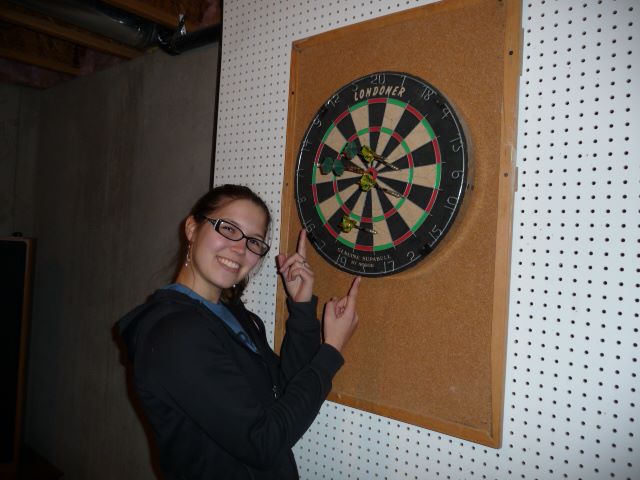
I got a double bulls-eye playing darts... purely by accident.

A view of the rockies from our drive up to Estes Park

Me and Sugar, the mare I was given to ride.

One of the beautiful elk we saw sleeping in Estes Park.


Anyway, back to the trail ride...Let me paint the scene for you. I have ridden in CO many times, but never here, as it was one of the few places open in Winter. So we drive up, and first of all, can't find the proper driveway for the place. Then, when we finally do, we drive through a lot of really old, pretty run-down buildings. Still kind of nice but... interesting. Once we get through the cabins and the lodge, we find the ranch part of the place. It's actually much nicer than the rest of the buildings... there were a lot of horses out in the paddock, but they all looked well-fed and groomed, and the barn was immaculate. The front office was filled with smoke and smoking older women. We checked in, and there were no liability papers to sign, or any papers for that matter, which seemed bizarre to me. Even when my friends come to ride, I make them sign a liability release.

We headed back outside, where the wranglers began to bring out horses and tack them up. There were ten going out for an hour through the mountains, and we composed four of those. Not too bad of a group. Their tack looked nice, and the horses were well-behaved. We checked out their longhorn and brama calves, petted some of the horses, and chased after the indoor, litterbox trained pot-bellied pig to get some pictures. We then leaned back to wait for the other guests to get there. I noticed one of the horses acting pretty restless, and then he started to lay down, still being tied to the hitching post. Well I wasn't about to let him ruin someone's saddle, so I hollered at him, and one of the wranglers who was a bit closer advanced toward him, at which point the horse jumped back to it's feet.

Strange, I thought. Most of the horses at the trail-riding places are used to their work and hardly notice the tack or the riders. So I kept watching him while the wrangler went to grab another horse. He appeared restless, and was tugging on his tie. I then noticed him starting to lift one of his back legs as if to kick at his belly. Little alarm bells went off in my head and I mentioned to Jared that it looked like the horse was colicky to me. He of course told me to keep my nose out of it- it wasn't my horse and I wasn't a vet. Luckily, the wrangler came to the same conclusion I did. He untacked the horse and tied him up, then called some of the other wranglers to come help out with the guest horses. He walked the horse and listened to it's belly. His body language got continually more stressed, and the wranglers attitudes began to plummet. The main wrangler, after seeing, I guess, that I got paired up with the most advanced rider horse, or maybe overhearing my comments, or seeing my troubled glances, came up and discreetly told me that they had recently lost 2 horses to sand colic, and he feared for this one. I asked if he had a vet close by, and he indicated that one was very close to the ranch.

From pieces of information dropped by the various wranglers, I gathered that they thought something to do with the hay they had been giving was causing the problem, and that they had been giving mineral supplements since the first horse had gone down. The hay they were currently feeding looked to be very green alfalfa. The colicky horse continued to get very bad, very fast. He began trying to lay down any chance he could get, despite the walking, trotting and circles that the main wrangler was getting him to do. The main problem began when he handed the horse off to a younger wrangler (about 16), who appeared to have no idea what to do with the horse. Not only did she let him get down and roll at least twice, she also just let go of the lead at one point when he started tugging and let the horse run away and then roll, and then later her own horse got away and ran around. It was terribly frustrating for me to watch this occur and be able to do nothing about it. They needed a vet and needed one fast, and I unfortunately, am not there yet. I do not have the knowledge, the experience or the authority to help, to give advice, or to work on the horse. All I could do was stand there and watch the horse deteriorate. Someone eventually gave him banamine paste and an injection of something, and they took him into the stall, and then took us out on the trail.

Because of the emergency, we got out half an hour late... but instead of giving us the full hour, they rushed us back after about 20 minutes on the trail. No one was in a mood to complain, especially not the other 6 members of the trail ride who had little to no horse experience and were quite wigged out by the scene that had unraveled in front of them. My mount was nice and responsive. I even got a few trot steps in, and made her wander off the trail a few times. I enjoyed the beauty of the short ride, and the companionship of my family, though a large part of me wanted to be in that stall seeing what they were doing. When we returned, one of the wranglers informed me that they could no longer get the horse up at all, and that they suspected he also had pneumonia on top of the colic. I left feeling a bit heavy-hearted, but also reminded once again of why I want to be a vet. I don't want to be standing on the sidelines, with my hands itching to help, feeling empty of knowledge. I know I won't be able to save them all, or even to have the ability to, but I want to have the knowledge and the opportunity to try.

~Melissa

Friday, January 4, 2013

My first LDA Surgery!

The first herd check today was cancelled, but instead I got to see a federal veterinarian come and test a goat for a false positive TB test. The original TB test had caused a slight reaction, and thus Dr. C. reported it to the state. They then sent someone out to do further testing. They shaved two patches on the goat's neck, and took skin thickness measurements. One patch was injected with the Bovine strain of TB, and the other with the Avian. The Avian is not considered harmful to humans, and goats can still be shipped for export to other countries even if they carry it. It is the Bovine strain that is the problem. They will wait 72 hours and retest the thickness of the skin in the areas (essentially, how much swelling occurred). This gives them some comparison as to whether it is one strain or the other, or whether it is simply a reaction to the vehicle (which is much more likely since TB in goats is very rare, especially in a 6-month old who was born on the farm and has never been off). The veterinarian who did it is a retired dairy vet from Minnesota, and he was really interested in talking to me about the role of veterinarians on the state and federal level, and pointing out that there are job shortages, and also that VMRCVM is a really good school for going into regulatory medicine. It is certainly something to keep in consideration.

Our second call was for surgery! This was probably the most serious surgery I have seen yet, and especially in large animals, so I was really excited to see it. Dr. C. started out by numbing the back left stomach area (behind the rib cage) of the cow, and making an incision on her right side, about ten inches. All of this was of course done after clipping and scrubbing. He cut through to the abdominal area, and then stuck his arm inside her gut. I can't imagine how funny that felt for the cow! Anyway, since there is a negative pressure in the abdominal area, you could hear a WHOOSH of air when he exposed it, and the cow almost appeared to inflate slightly. He stuck a needle and tube in her abomasum to draw out the air, and then moved the stomach chamber back into place. He sutured it to the stomach wall to keep it from floating off again, and sewed her back up. The scrubbing took about half an hour, and the surgery about the same. If you are interested in seeing something similar, I found a good one on youtube. It's really funny because you can hear the farmer talking to his cows the entire time :P

Our last call for the day was just for a herd check, at a somewhat run-down farm. I saw one cow jump a gate and get it's back legs caught for about 10 minutes, and another scramble under a fence... It was interesting. Their cows were mostly pregnant as expected, with only 1/20 having a uterus problem needing meds. It had pyometria, or in layman's terms, pussy uterus. 

So now I'm back home again and starting to get the house cleaned up. I will be silent for about a week, since I am heading to Colorado to visit with my family out there. I will update with pics, etc. on my return! I hope everyone has a wonderful weekend and week.

~Melissa


Wednesday, January 2, 2013

A New Year, A New Experience

So now we come to yesterday and today's events. Yesterday was recovery (for Jared) and catching up on things that needed to be done. We mucked out the horse stalls (which had some accumulation due to snow and our poor barn design), and filled up the truck with a load of firewood from my grandfathers. We brought in two stacks of wood into his basement, hopefully enough to keep him for a month or so before we need to do some more. We try to bring it in so he doesn't have to go outside to keep his furnace burning- we all worry about him falling or catching cold. He is still an active old guy in his 70's, and hunts, fishes, crabs, gunsmiths, you name it. But as the years progress, he gets out a little less and if we can make his life a little easier, we certainly try. Once we got him all taken care of, we took our load up to the house and stacked it in our basement. We had an innovative little system going on... Jared parked the truck at the top of our basement steps, and we put a wheelbarrow at the bottom. He tossed wood into the wheelbarrow, and when it was full I wheeled it in and stacked it, while he pulled out the next wheelbarrowfull from the back of the truck. We got it finished in about half an hour, so it wasn't too bad. Finally, we headed over to my neighbor's so I could  take care of his horses for the night. Boy was I tired when we finally got home. After a hot shower and some of my grandmother's soup, I was out like a light.

My alarm went off at 6:30 am and I headed out to get the house full of animals fed and taken care of before heading over to Dr. C's at 8 am. We jumped in the truck and headed out for our first herd check, at a decent sized farm not too farm down the road from him. We preg-checked about 30 heifers, many of whom had not taken from the last breeding. Only about half or less were pregnant. Two of the cows appeared to have calves about 35 days old... which the farmers didn't have records of them having been bred at that time. So that was pretty bizarre, especially since Dr. C. said everything felt completely normal in them. There were two uterus infusions that I got to see, with tetracycline being flushed in for antibiotic purposes. They put a long hollow tube into the uterus, and Dr. C. feels out where the end should go based on the infection and status of the uterus. There was a mild incident that occurred that really sunk into me how dangerous cows can be. Dr. C. was in the chute, and the farmer wasn't paying attention (and nor was I, since I was watching Dr. C.!). Another cow butted her way in and shoved Dr. C. against the other cow and the gate. He was getting squeezed with his arm still stuck in another cow. It was terrifying. They managed to get the one cow back enough so that no damage was done, but I'm sure his rib cage will hurt a bit tomorrow from being pancaked.

We also ended up doing a different type of dehorning at this farm. These owners did most of the cauterizing dehorning themselves, numbing the calves first with Lidocaine. However, they had let about 10 of the calves get too big, and they needed something more extreme than the cauterizer. So I got to see something a little different. Dr. C. numbed the calves' heads, and then we went down the line with what I call "scoops." I held each calf's head down for him, and he used these tools essentially like giant pliers, to cut around the calf's horns, taking some scalp along with it to make sure all of the horn-producing cells were removed. He then pulled on each of the four main arteries that run around the horn, until they snapped off under the surface, where the pressure of the tissue would cause them to stop bleeding. To doubly ensure that the cow's didn't bleed out (though he assured me that this was extremely rare), the farmers went behind us and cauterized the area with the heat dehorner. One of the calves, who had abnormally large horns for her age, also had these strange holes left behind after we removed her horns- these were actually her sinuses!
 The calves could hardly feel any of it (as you could tell from their lack of struggle), which made me feel a bit better than some of the earlier dehorning, where they are thrashing and bleating plaintively (yeah, I'm a wuss).

The next farm we headed to was for a cow who needed to be "cleaned." That is, she had calved on Friday and not all of her afterbirth had come out. She was a little weak in the hind end and we couldn't get her up due to slippery floor conditions, and since it was just Dr. C. and me (the farmers weren't around), he did as much as he could with her lying down. He pulled out a lot of her afterbirth (which smelled pretty bad), and cleaned her up. He also put in some antibacterial "pills" which were each the size of his thumb. They would dissolve in the uterus and keep infection down.

Our last call was to do some more foot work on a cow with an ulcer. Dr. C. cleaned her up and bandaged her foot, and then we headed back to the office. We were done by twelve thirty, and I was home by 1, quite an early day!

Tomorrow I am going in to the small animal hospital in the morning, then having lunch with an old, dear friend and his significant other, whom I'm excited to meet. He goes to Mizzou, and so does she. In the afternoon I'm heading up to go help out at my stepfather's new building that his business is expanding into. I should be helping with some wall painting and whatever else they need! So it should certainly be a fast-paced day.

Hope you have a wonderful evening,  and thanks for taking the time to read my rants! I hope someone out there is getting something out of it. If anyone ever has any corrections, clarifications or questions, I would love to hear them.

Thanks!

~Melissa


Monday Funday

I'm just going to make a quick entry about my Monday before I head off to do some day's chores. I'll update you all about the rest later tonight! It's also probably better this way so that you don't have to read a huge entry... instead you can read two medium-length ones :)

Monday I went out with Doc, the equine vet I've been shadowing since Freshman year of college. He only had one call, but it was really nice to get out on the road with him. I miss vet work on horses, and I miss him and Ms. S., his tech. No one is quite like Doc. All three of us piled into the vet truck and headed out on the road around noon, after Ms. S. and I fed his horses and chickens, and mucked his stalls (Doc has a bad back so he doesn't do too much of this if possible).  We went out to look at a 21-year old gelding with a very swollen stifle. We suited up and took medial and lateral x-rays of his stifle. They came out looking good in regards to arthritis, but there was some indication that the horse's cruciate ligament was torn (it's ACL). Doc then positioned his shoulder and hands in order to rotate the "kneecap" and see if he could feel the femur and tibia moving separately, rather than together (as the should). Indeed, compared to the horse's other stifle, this one was quite wiggly. Even cooler, he then positioned my hands and shoulder and helped me move the leg so that I could feel it. I have had the opportunity to do so in a dog, but never in a horse (nor did I think this was possible!), so this was a first.

We took from "M" and "L" areas approximately


He recommended taking cultures of the stifle joint fluid, and then, pending the results, inject with cortisone. He explained the different possible positions for injections and drawing off fluid for culture and the pluses and minuses of each position. I twitched the horse while they shaved, scrubbed and stuck him, and I have never seen joint fluid squirt like it did out of this horse's knee. It was a steady stream, and I am sure that that pressure relief felt pretty darn good for him. They caught the spraying liquid in culture vial, one from each side, and we later dropped it off at the hospital for analysis.

Once I arrived home for the evening, Jared and I headed up to my cousin's New Year party. I have never been to a New Year party before (and the number of parties I have attended could be ticked off on one hand), but I actually had a really good time watching all the drunk (and not drunk) people! My cousins even arranged for a friend of theirs to come who is a vet tech looking to apply to vet school next year, so I had someone to geek out with all night. She is a 2009 grad of Mt. St. Marys, another small liberal arts college from just down the road. I think I gave her some good tips of things to look into (like Student Doctor Network!), and she as well gave me some good tips. If we are both EXTREMELY lucky, we may even be attending VMRCVM together in 2014... guess we will see!

~Melissa

Saturday, December 29, 2012

Mummies

Well it's snowing here, so I figured I would go ahead and update from my adventures yesterday. I headed out to Dr. C.'s around  8 am and we got out on the road shortly thereafter. He is always waiting for me to get there, with the truck warmed up and everything, but I am always there when he wishes me to be. He is one of the few vets I have met who is extremely timely, which I really love. We only had two calls on the schedule. The first was a herd check at a Menonite farm. The set up there was really nice. I felt a little uncomfortable at first (which was rather naive of me), since I know that women in their community normally keep their hair covered, and mine was it's usual messy self, though tamed slightly into a ponytail. But the two sons and the father were just as humorous and nice as every other farmer we have run into. We did some pregnancy and heat checks, then some podiatry work on a heifer that had an ulcer. Dr. C. had done some work on her last week, but she had actually gotten worse. He cleaned out another area of the hoof, found the beginnings of some hoof rot between her toes, and put her on a new regiment of medication to treat that. We also did some more dehorning, and some cattle vaccination. With the vaccinations that we gave, the calves also got an ear tag and a tattoo in their ear.

The next farm we headed to was for castrations. Three angus meat calves needed to be vaccinated and castrated. I've seen plenty of horse geldings, and neuters on dogs, but that was far from what happened with the calves. Instead of the sedation, clamping, tie offs and re-closure I am used to, the cattle castrations were quick and dirty. The calves were put in a head gate, and Dr. C. vaccinated them. He then pulled out a wicked-looking tool from his sanitized bucket and solution. He checked to make sure the calves had both testicles descended, and then took the tool and slit open the scrotum sac, exposing the testicles. He then reached in, broke the ligaments with his fingers, clamped on the arteries and pulled the testicles out. Literally just cut a few strands, including the vas deferens, and then sprayed liquid bandage on it and the calf was done. It took about 30 seconds to a minute for the whole procedure. Dr. C. explained to me that if the blood vessels weren't properly clamped down upon (which he did with his fingers alone), then you could cause the calf to bleed out in a matter of seconds. With all that he did, I didn't see a drop of blood come out. It was very interesting.

By this time it was around noon, and he had gotten a whole pile of phone calls while we were on the farm. We had three emergency calls. The first was for a downed beef cow. In a whole pasture of cows, this lone girl was down in the mud, steaming and shaking. She was able to get up a few steps, but then laid right back down, clearly weak. After looking her over, Dr. C. determined that she most likely had toxic ingestion. He gave her a bottle of some sort of calcium fluid IV in the neck to help balance her out, as well as some banamine and another IM injection which I can't remember the name of (oops). The cow was also pregnant, so he had to be careful what he gave her so that she didn't abort. He left the farmer with instructions to get her up and isolated via hip slings or tractor bucket so that she could have time to rest and regain her strength without the other cows bothering her.

The second emergency call was for three sick cows. All were heifers, and all had different uterus problems. One had chunks left over in her uterus from her most recent calf, one was slightly pussy (indicating infection), and one had a mild case of mastitis on top of having a infection in her uterus. All had been off their feed and down in milk production, the usual indicators of disease for farmers.

The third emergency call was much more bizarre. A pregnant heifer had gone down in the field about a month before, and the farmers thought she must have had or aborted a calf, but couldn't find it. The cow appeared healthy and had no problems, so they continued to milk her without an issue. About two days ago, she had been losing "cleanings" from her vagina, which the farmers had been pulling out. Today, however, they found a tail sticking out, and called Dr. C. He was a little puzzled by the whole thing, but as soon as he examined the cow, what had happened became evident. When the cow had gone down a month ago, she had halfway aborted her backwards calf. It had left the uterus, passed the cervix, and stopped in the vagina. It was still able to survive however, since the placenta was still attached and functioning, and it did. It continued to grow, though much stunted by space. It had recently died, a day or two ago, which is when the cow had started to pass bits of her placenta, and was trying to push the calf out. The calf in the meantime, began to mummify slightly. So Dr. C. pulled out a partly mummified, backwards, very small calf. The cow, I swear, let out a sigh of relief when it came out. She was slightly damaged and stretched out from the odd calf placement, but would probably be able to be bred again in a month or so. Dr. C. said that was the first time he had ever seen this happen, and remarked on how bizarre it was!

I ended up getting home around 4:30 and immediately jumped in the shower (I can't tell you how hard it is to get the smell of calf dehorning out of your hair and skin). Jared and I headed out to dinner and a movie, which was really fun since we hadn't been out on a date in months.

I am heading out with Doc (the equine vet) on Monday, am riding along with Dr. C. on Wednesday and Friday,  and am going in to the small animal hospital on Thursday. So it should be a busy week!

~Melissa

Thursday, December 27, 2012

It's Liquid! It's Pus! No it's... Inky Black Fluid?


First of all, I hope everyone's holidays went wonderfully, whatever they were and whomever they were held with. Mine involved a great deal of driving around, and included some interesting highlights, which I will refrain from truly extrapolating on. I had some very generous and wonderful family members (and not yet family members), who gave me some awesome presents this year. I got gift cards to TSC (chicken food), Rue 21 (my favorite store which I haven't shopped in in months due to lack of excess money), Sheetz (gas!!), Kennies Market for groceries and Outback Steakhouse so Jer and I can go out. I also got some beautiful and much needed sweaters, a pair of gorgeous cowboy boots, and two books by my favorite author (Iris Johansen). I was blown away by the amazing generosity of my family this year, as well as of Jared's family. All the things I got were very appreciated and more than I have ever received on a holiday.

The favorite gifts that I gave were two tiles I painted for my mom.
Her cat, Oreo
Her horse, Blossom


We also got snow on Christmas Eve (which I can tell you was a pain to drive home through). It was very pretty and all, but I really am not the biggest fan of snow. Remi
(or Rem-Dog as we have taken to calling her) absolutely LOVES snow more than anything else. If you can imagine a lab's normal enthusiasm and multiply it by about 3, you would have it right.  She belly-slides across the snow, burrows in and on it and under it, and would do it for hours and hours. That in itself is enough to almost make me like snow :)


Yesterday I  had a terrible migraine and my stomach was acting up. So I ended up calling Dr. C. and not going in to shadow. About an hour after I called him the snow and sleet started, and I was very glad that I had stayed home. I'm a bad driver at the best of times, and in snow I basically become a death trap. So I stayed home and played on the XBox that Jared got me for X-mas (breaking our pact of no gifts! > ( ), and let him take care of me. I've never had my own game system before (discounting the hand-me-down PS1), so it is pretty fun to be able to do what I want on it.

And that brings me to today (which I know you really want to hear about after the title of my post!). I shadowed at the small animal hospital starting at nine. I saw a spay and a neuter, and the usual vaccines for cats and dogs, skin allergies to fleas, cats with bad teeth, cats with dandruff and hair loss, etc. Under close supervision of a vet and a tech, they even let me intubate a dog today. I also met my first of three different purebreeds... a borzoi, a wolfhound and an elkhound. The most interesting case to tell about was an 18 year old cat that came in, looking absolutely beautiful in coat, color, teeth, what-have-you. It hadn't seen a vet since it had been neutered at a year old. I would never have guessed this cat's age.... it looked like a 6 year old! Anyway, they had brought it in for a strange lump on it's side which had marginally increased in size over the last few months. It looked like a strange nipple on his right side, with a sac behind it. We took the cat in the back to have a look at it, and Dr. H. poked a needle in to check the fluid color (clear is good, pus and blood is bad), and out squirts (literally), this black, thick, fluid. It resembled liquid charcoal. It didn't smell, and once she poked it it all wanted to come out, and you could hardly find the cyst when it was empty. It was rather bizarre. We made slides of it (just out of curiosity sake), and couldn't identify anything much in it besides what looked like fat cells. So it will probably stay on the side of the cat and continue to make it's strange product!

I left the hospital around 4 and headed out to get horse, chicken and cat food from various stores. Now I'm all stocked up for a bit, and when the predicted storms hits this weekend, I won't have to worry about feeding all my menagerie!

I'm headed out with Dr. C. tomorrow, so check back to hear about my day with dairy.

Thanks for reading!

Melissa

Saturday, December 22, 2012

More Cows and Family Christmas

Yesterday I headed out with the cattle vet again. We started the day with a "nursery barn"- not the official name but that's what I call it. These are farms where farmers essentially board their calves until they go into their first pregnancy and begin producing milk. This is definitely an interesting way of handling the dairy cow production system.The young cows being raised on the farm would take up space and feed that producing cows could use, and so the calf farms are really a necessity for the volume of milk that farmers need to produce to stay  afloat. Since cows normally have their first calves at about 2 years of age, the calves leave the main farm once they are off of milk, and stay at the nursery barns until they are two. Most nursery barns also work with the young cows a lot to get them friendly and used to people and equipment, so that they are ready to "do their job" once they return home.

We were doing pregnancy checks there on the older heifers, and I got to learn to herd and cut cattle to get them one by one into the run and head gate. They tend to follow the fence and have a little more prominent "shy" zones than horses, making them much easier to herd. I felt like a sheep dog in the pen, but I had a great time, even though it was very cold. The farmer who ran the barn kept making jokes to me and encouraging me on, and Dr. C. was plenty patient with me, even when I turned them the wrong way. He and I are continuing to get to know each other, and he even gave me some small things to do (even if it was just holding things and herding cows!) which not only made me feel somewhat useful, but also helped keep me warm!

We got an emergency call shortly after we left this barn and were heading to another. It was for a cow off her feed. On the way over the farm, I picked his brain about what the first things were he looked for in cattle when evaluating them for possible sickness, and common ailments. The main thing he mentioned, which it turned out to be, was a displaced abomasum (D.A.) or twisted stomach.

When we got to the farm, it was deserted. We couldn't find a single person, though we found the sick cow and looked her over. Her temperature was low at 99. Dr. C. showed me her lymph nodes and had me feel for them, and then let me listen to the "ping" that acompanies a D.A. The D.A. is caused by gas being overproduced in the stomach, either from poor nutrition, sickness or a secondary symptom of another disease. This causes the stomach to move around inside the body cavity, getting out of place. It can move either to the right or left side of where it is supposed to be. In this case, it was the left. When a stethoscope is placed on the side of the cow, and her side is flicked, rather than the dull thud you would expect, you get a "ping." It is an almost tinny noise that occurs from the gas.


The treatment for this could have been medical or surgical; the owners (once we tracked them down via phone), opted to try for the medicinal and go with surgery if needed. The cow was put on antibiotics (since her uterus also had pus in it), and would have baking soda put in her feed for the next couple of days, as well as calcium and some banamine being given in vein. Why baking soda? Well, calves have a special pipe that transports milk directly from their mouth to the abomasum, the main compartment of the stomach. This allows it to bypass the other compartments (the rumen, reticulum and omasum) and go straight to where it will do the most good. This tube is essentially unused once the calf is weaned, but it still exists. The pH of baking soda, being similar to milk, causes the flap covering the hole to open up, and the baking soda, a bicarbonate, acts to reduce acidity and gas in the abomasum. If it doesn't after a few days, then surgery (necessitating the stomach wall being sewed to the body wall to keep it in place) becomes necessary. Really interesting to learn about.

Our last farm call was to a small dairy farm (about 40 milkers). The facilities there were really nice, though the farm was small, and you could tell that the farmer really took care of these cows. They all had fresh straw and clean bedding, with the poop being removed very quickly after it occurred. The cows were quite friendly as well, and very clean (for cows!). It almost looked as if he brushed some of them! We just did some more pregnancy and heat checks on these cows. Dr. C. explained to me what he felt for upon palpation and the main signs of pregnancy and heat in the uterine structures. He also gave me a comparative anatomy lesson between horses and cows reproductive systems, which is summarized in the diagrams below. Cows truly have uterine "horns"- they even curl under! The development of placenta is also a lot different in both species.
Horse


Enough about cows though. Today was the family X-mas party. We held it at my house this year, which was quite fun! Remi got to wear her jingle bell collar all day, and we lit a fire in the upstairs fireplace. Many of my cousins and relatives who I don't often get to see were able to make it up, which was great. We ate off of paper dishes so that there wasn't much to clean up, and my grandmother stuck around and gave me a hand afterwards, since Jared had to go to work. Made for a nice and easy day! I have so many leftovers in my fridge :)

Melissa